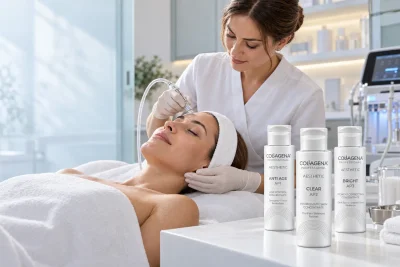
Hydrodermabrasion, also called hydradermabrasion or aqua peel, is a facial treatment in which a device cleanses and exfoliates the skin with a jet of solution and a vacuum. The solution is not an extra on top of the treatment but part of it: the skin receives it with every pass of the tip.
This article is for salons that work with a hydrodermabrasion device or are thinking of starting, and for anyone who wants to understand the treatment before booking it. The first part is about the treatment itself: how it works, how it differs from microdermabrasion and peels, what the studies show, when it is postponed and what comes after it. The second part covers the Aqua Peel concentrates from the Collagena Professional Aesthetic line, which we have offered since October 2026: which concentrate for which skin, and how the solution is prepared.
What Hydrodermabrasion Is
The dermatology literature describes hydrodermabrasion as a variant of microdermabrasion without abrasive crystals. Instead of crystals, a jet of liquid is directed at the skin to loosen dead cells and surface debris, and the vacuum draws them away. The difference from classic microdermabrasion is that in the same pass in which it exfoliates, the device also applies a solution. That solution can be formulated for a particular skin need, something crystal microdermabrasion cannot do.
The earliest study of the method in PubMed, from 2008, defines it in exactly these terms: crystal-free microdermabrasion combined with applying a serum under pressure.
One treatment, several names
In English the treatment is most often called hydradermabrasion or hydrodermabrasion, less often wet dermabrasion or aqua peel. In Bulgarian salons it goes by водно дермабразио, хидродермабразия, хидродермабразио, хидрадермабразио or аква пилинг.
HydraFacial, a name often used as if it were the method’s, is one company’s trademark for its own system, not the generic name of the method. Other manufacturers have their own systems under their own brands. That is why this article uses the generic name, hydrodermabrasion, as the leaflets of the Aqua Peel concentrates do.
How a Hydrodermabrasion Device Works
Devices differ in design, but the principle is shared. The tip is placed on the skin and the vacuum draws the skin towards it. The solution runs through the tip onto the skin, and the used liquid, together with what it has lifted, is drawn into a closed waste container. On some devices the amount of solution depends on the vacuum strength, and the vacuum strength and the number of passes are adjusted to the skin and to the result wanted.
Device makers and salons describe the treatment in three phases:
- Cleansing and exfoliation. The jet of solution and the vacuum loosen dead cells and surface debris.
- Extraction. The vacuum draws away what has been loosened, together with the used solution.
- Hydration and protection. A hydrating solution is applied to the skin, and the treatment ends with skincare and sun protection.
Before all of this the skin is cleansed, and the consultation establishes whether the treatment is suitable on that particular day. When it is not suitable is covered below.
How It Differs from Microdermabrasion and Chemical Peels
The three treatments are often confused because all three exfoliate. The difference is in what they exfoliate with, and in what follows:
| Treatment | How it exfoliates | After the treatment |
|---|---|---|
| Microdermabrasion | Microcrystals (aluminium oxide) that the vacuum draws back, or a diamond-coated tip | The skin may be pink or red and slightly swollen for a day or two |
| Hydrodermabrasion | A jet of solution and a vacuum; in the same pass the skin receives the solution | In one study: no visible redness at mild settings; at stronger ones, redness that faded within 2 to 5 days and, per the authors’ conclusion, bruising for 3 to 5 days |
| Superficial chemical peel | An acid, such as glycolic or salicylic acid, removes the surface layers | Mild redness and occasional swelling, which usually settle within 48 hours |
Hybrid systems also exist: a device with a diamond tip that exfoliates and applies a serum under vacuum at the same time.
The line between hydrodermabrasion and a peel is not sharp either. Some hydrodermabrasion solutions contain acids: one of the studies combined the vacuum with a 4% AHA solution. The AP1 and AP2 Aqua Peel concentrates also contain mandelic acid and PHAs, and the concentrate itself is diluted 1:10. The accurate description in that case is a mechanical treatment with a solution that contains acids for gentle exfoliation, not a chemical peel in the dermatological sense. How peels themselves work is covered in the article on chemical peels and active serums, and the acids in the complete guide to AHAs.
What the Studies Show
The scientific evidence on hydrodermabrasion is thin. A PubMed search (October 2026) for the method’s various names finds five publications with participants and no systematic review. The studies are small, from 8 to 29 people; three have no control group, and two have authors from companies that make the devices.
What they found:
- Freedman, 2008. 20 women aged 34 to 56, in two groups, each with six treatments 7 to 10 days apart. In the group treated with the device and an antioxidant serum, fine lines, pore size and pigmentation decreased, with no complications. In the group that had the same serum applied by hand, nothing changed. There was no device-only group, so the study does not show what the serum itself adds.
- Kim, 2015. 23 women with acne-prone skin and a single treatment: one half of the face with a 4% AHA solution and a vacuum, the other with the solution alone. The two sides differed only in blackheads and whiteheads, and only at the one-week measurement.
- Razi, 2024. 8 people, one treatment, followed with skin imaging. The stratum corneum thinned right after the treatment (from 9.42 to 6.67 micrometres) and measured 9.75 micrometres two weeks later. Two weeks on, the collagen fibres showed no visible change. All eight participants felt their skin was smoother.
- Storgard, 2022, and Huang, 2024. Six treatments two weeks apart, no control group, with the manufacturer’s devices and serums; in the first the treatment also included LED light, and in the second the participants also used a serum at home. Both report good tolerability.
The conclusion: small studies suggest that the treatment is well tolerated and can leave the skin’s surface cleaner and smoother. There are no long-term studies and no comparisons between devices. A result from one device and one serum does not automatically carry over to another device or another solution, and none of the studies used the Aqua Peel concentrates.
Contraindications: When the Treatment Is Postponed
The manual of one diamond-tip device and salon practice list conditions in which the treatment is not done, and dermatology guidance adds cases in which a doctor should be consulted first.
The treatment is not done on:
- sunburned or windburned skin;
- extremely dry, chapped, irritated or broken skin, and open wounds;
- active acne with open, weeping lesions;
- active cold sores.
A dermatology review advises using microdermabrasion with caution in rosacea and on sensitive or thin skin, because of a higher risk of irritation and hyperpigmentation. During a rosacea flare the treatment is postponed.
A doctor is consulted first if the client:
- Is taking isotretinoin or stopped it within the last 6 months. The American Academy of Dermatology warns that microdermabrasion then carries a higher risk of complications, including scarring. A 2017 systematic review found insufficient grounds to postpone superficial peels but advised against mechanical dermabrasion during treatment; hydrodermabrasion was not studied.
- Is pregnant or breastfeeding. There is no study data on hydrodermabrasion, and skincare during pregnancy has its own limits.
- Has a mole or spot that is growing, bleeding or changing, or skin that scars easily.
Also ask about:
- allergies to ingredients of the solution; for 3-O-ethyl ascorbic acid, for example, individual cases of contact allergy have been described;
- medicines applied to the area;
- a recent chemical peel or laser treatment;
- a tendency to develop dark spots after acne or an injury: according to the American Academy of Dermatology, such skin has a greater risk of new dark spots after microdermabrasion.
How the conversation itself is run is covered in the article on client consultation.
Aftercare
According to the manual of one diamond-tip device, a scratchy, stinging feeling during the treatment and temporary tightness, redness or slight swelling afterwards are typical. Rarely, severe irritation, an allergic reaction, a rash, burning, itching, dryness or peeling may occur: the treatment is then stopped at once, and a doctor is consulted for an allergic reaction.
For the first days, salons in Bulgaria often advise:
- no make-up for about 12 hours;
- two days without saunas, sunbeds, intense workouts and products with retinol or acids;
- sun protection every day.
The same manual recommends sunscreen with SPF 30 or higher after the treatment, and some salons advise SPF 50. It matters most after a solution with acids: AHAs, such as the mandelic acid in AP1 and AP2, increase the skin’s sensitivity to the sun, and the FDA data on this come from four weeks of using a product with AHAs. How to choose sun protection is covered in the article on photoprotection, and care after different treatments in post-procedure care.
How Often It Is Done
There is no accepted recommendation on how often to have hydrodermabrasion. In the studies with more than one treatment, the schedules were six treatments 7 to 10 days or two weeks apart, but those are study schedules, not recommendations. Salons in Bulgaria most often offer a monthly maintenance treatment, sometimes after a starting course of treatments one or two weeks apart.
For comparison, for microdermabrasion the American Academy of Dermatology says most patients have between 5 and 16 treatments, weekly, every two weeks or monthly. According to the academy, most people can safely have another treatment a week later, though some need several weeks to recover. The guide is the skin: the next treatment is done once it has fully recovered from the last one.
What Hydrodermabrasion Does Not Do
- It does not replace medical procedures. Volume loss, deep lines and laxity are a question for a doctor; where the line runs is covered in the article on non-invasive aesthetics.
- It does not treat skin conditions. Acne, rosacea and melasma are treated by a dermatologist; the salon works with the skin’s appearance.
- The collagen in the solution does not replace the skin’s own. The collagen and elastin in the solution stay on the surface and do not become the skin’s collagen and elastin.
- It does not give a permanent result. The results of microdermabrasion are temporary and last longer with sun protection and home care, and for hydrodermabrasion there are no long-term data.
Aqua Peel from the Collagena Professional Aesthetic Line: Which Concentrate for Which Skin
The device does the mechanical part: it exfoliates and draws away. The solution decides what the skin receives in the meantime, which is why solutions are formulated for particular skin needs.
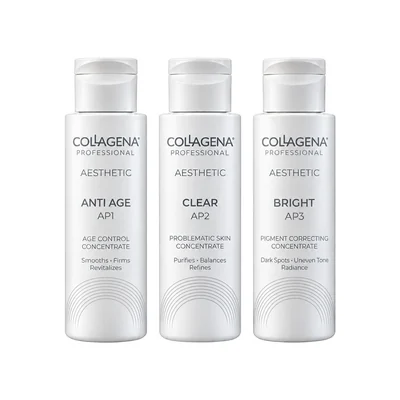
The Aqua Peel concentrates belong to the Collagena Professional Aesthetic line and are for professional use in the salon only. There are three, each for a different skin need:
| Skin need | Concentrate | Actives |
|---|---|---|
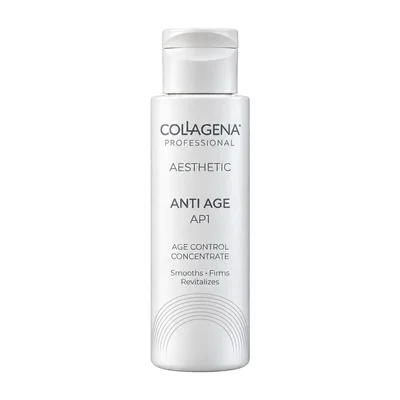
| Signs of ageing | AP1 Anti Age | Sharohyal Moist PHA, centella and hibiscus, elastin, DNA and collagen, rice water |
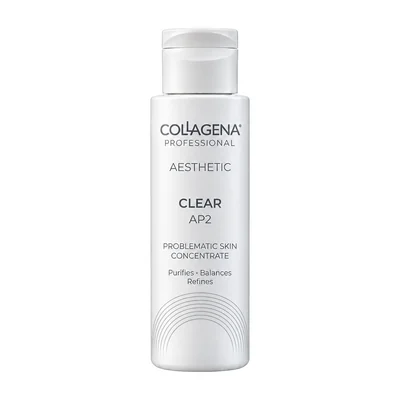
| Blemish-prone skin | AP2 Clear | Postbiotic, BB-Biont™, green tea and collagen, Sharohyal Moist PHA |
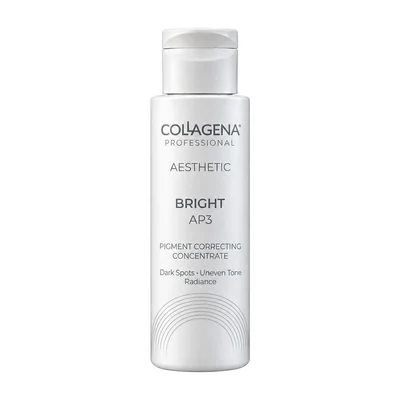
| Uneven skin tone and visible dark spots | AP3 Bright | Vitamin C (3-O-ethyl ascorbic acid), niacinamide, licorice, bearberry, passionflower and collagen |
AP1 Anti Age: for signs of ageing
AP1 pairs gentle exfoliation with hydrating care. The leaflet states that PHA, mandelic and hyaluronic acid support a smoother, more even texture, and that the plant extracts, collagen, elastin and DNA round out the care for soft, supple and comfortable skin.
In the list of actives, the three acids appear under the name of one raw material, Sharohyal Moist PHA. According to its maker, it contains mandelic acid, two PHAs (gluconolactone and lactobionic acid) and cross-linked sodium hyaluronate. PHAs are described as acids with effects similar to AHAs but without the stinging and burning that limit classic AHAs, and with an additional moisturising effect; one of the reviews also mentions combining them with treatments such as microdermabrasion. The data on PHAs come mainly from researchers linked to a PHA developer. Mandelic acid is an AHA with a larger molecule than glycolic acid, and reviews describe it as well tolerated. Hyaluronic acid holds water and hydrates the skin’s surface; its cross-linked form in cosmetics is not a filler and adds no volume.
Collagen works on the surface: it holds moisture and leaves a thin film. The whole molecule is too large to cross the epidermal barrier, and the fragments of a hydrolysate do not reassemble into collagen in the skin, which is why “rounds out the care” is the accurate description of its role. There is more on this in the article on collagen in skincare. Extracts of centella and hibiscus, and rice water, also round out the care.
AP2 Clear: for blemish-prone skin
AP2 is a concentrate for blemish-prone skin. According to the leaflet, the postbiotic and BB-Biont™ support the balance of the skin’s microbiome, green tea extract rounds out the soothing care, and the Sharohyal Moist PHA acid complex supports gentle exfoliation and smoother-looking skin.
The skin microbiome is the diverse community of microorganisms that live on the skin and interact with it. A postbiotic is a preparation of inanimate microorganisms or their components. BB-Biont™ is a peptide ingredient (palmitoyl pentapeptide-4) from Sederma, part of the Croda group. Green tea extract is a source of catechins, to which reviews attribute antioxidant properties.
What counts as a blemish is covered in the article on types of blemishes. If there is active acne with open, weeping lesions, the treatment is postponed, and acne as a condition is a matter for a dermatologist.
AP3 Bright: for uneven tone and visible dark spots
AP3 is a concentrate for uneven skin tone and visible dark spots. According to the leaflet, the stable vitamin C derivative and niacinamide support a more radiant, even-looking complexion, and the plant extracts and collagen round out the care for smoothness, hydration and comfort.
The form of vitamin C is 3-O-ethyl ascorbic acid. Pure ascorbic acid oxidises readily in air, and this derivative was developed as a stable form; the differences between the forms are covered in the article on vitamin C concentrations and stability. Niacinamide is among the better-studied cosmetic ingredients: in controlled studies, products with 2 to 5% niacinamide improved the look of dark spots and of skin tone. Those studies, though, used products left on the skin every day for weeks, so their results do not carry over directly to a single treatment. Licorice, bearberry and passionflower extracts round out the care.
What the ingredient descriptions mean
The ingredient data above come from research on the ingredients themselves, usually in products left on the skin. They explain why the ingredients are in the concentrates; they do not promise the same result from a single treatment. A salon that works with different skin types can buy all three concentrates together in the Aqua Peel Set, at a better price than when bought separately.
How to Prepare the Solution
Each concentrate is diluted 1:10:
- Measure 50 ml of the concentrate.
- Mix it with 450 ml of distilled water until the solution is even.
- Pour the solution into the tank of the hydrodermabrasion device.
So 50 ml of concentrate makes 500 ml of solution, one tenth of which is concentrate. One 100 ml bottle is enough for two such solutions. How many treatments one solution covers depends on the device and the treatment, and the manufacturer does not state it.
Before using any solution, check the device manufacturer’s instructions. A manufacturer may accept only its own solutions: the manual of one diamond-tip device voids the warranty if solutions the manufacturer has not authorised are used.
In Short
- Hydrodermabrasion is crystal-free microdermabrasion: a jet of solution and a vacuum exfoliate, and the skin receives the solution in the same pass.
- The studies are small and suggest that the treatment is well tolerated and can leave the skin cleaner and smoother; there are no long-term data.
- The treatment is postponed on sunburned, irritated or broken skin, with active cold sores, and when there is active acne with open lesions; with isotretinoin, pregnancy and changing moles, a doctor is consulted first.
- After the treatment: no make-up for about 12 hours, no acids or retinol for two days, sun protection every day.
- The concentrate is chosen for the skin: AP1 for signs of ageing, AP2 for blemish-prone skin, AP3 for uneven tone. It is diluted 1:10.
Sources
The research below concerns the treatment and the ingredients in general, not the Aqua Peel concentrates. The product descriptions come from the Collagena Professional leaflets.
- Freedman B. M. Hydradermabrasion: an innovative modality for nonablative facial rejuvenation. Journal of Cosmetic Dermatology, 2008.
- Kim S. J. et al. The effect of physically applied alpha hydroxyl acids on the skin pore and comedone. International Journal of Cosmetic Science, 2015.
- Storgard R. et al. Efficacy and Tolerability of HydraFacial Clarifying Treatment Series in the Treatment of Active Acne Vulgaris. Journal of Clinical and Aesthetic Dermatology, 2022.
- Huang P. et al. Efficacy and tolerability of a novel cosmetic growth factor serum when used as part of biweekly diamond tip hydradermabrasion treatments on facial skin. Journal of Cosmetic Dermatology, 2024.
- Razi S. et al. Hydradermabrasion through the lens of Line-Field Confocal Optical Coherence Tomography. Skin Research and Technology, 2024.
- Loesch M. M. et al. Skin resurfacing procedures: new and emerging options. Clinical, Cosmetic and Investigational Dermatology, 2014.
- Spring L. K. et al. Isotretinoin and Timing of Procedural Interventions: A Systematic Review With Consensus Recommendations. JAMA Dermatology, 2017.
- American Academy of Dermatology. Microdermabrasion: FAQs.
- DermNet. Chemical peels.
- DiamondGlow User Manual. Allergan Aesthetics, AbbVie, 2023.
- U.S. Food and Drug Administration. Alpha Hydroxy Acids.
- Grimes P. E. et al. The use of polyhydroxy acids (PHAs) in photoaged skin. Cutis, 2004.
- Green B. A., Yu R. J., Van Scott E. J. Clinical and cosmeceutical uses of hydroxyacids. Clinics in Dermatology, 2009.
- Almeman A. A. Evaluating the Efficacy and Safety of Alpha-Hydroxy Acids in Dermatological Practice: A Comprehensive Clinical and Legal Review. Clinical, Cosmetic and Investigational Dermatology, 2024.
- Eternis Personal Care. Sharohyal Moist PHA (raw material description).
- Jadach B., Mielcarek Z., Osmałek T. Use of Collagen in Cosmetic Products. Current Issues in Molecular Biology, 2024.
- Byrd A. L., Belkaid Y., Segre J. A. The human skin microbiome. Nature Reviews Microbiology, 2018.
- Salminen S. et al. The International Scientific Association of Probiotics and Prebiotics (ISAPP) consensus statement on the definition and scope of postbiotics. Nature Reviews Gastroenterology & Hepatology, 2021.
- Croda Beauty. BB-Biont™ (raw material description).
- Koch W. et al. Applications of Tea (Camellia sinensis) and its Active Constituents in Cosmetics. Molecules, 2019.
- Iliopoulos F. et al. 3-O-ethyl-l-ascorbic acid: Characterisation and investigation of single solvent systems for delivery to the skin. International Journal of Pharmaceutics: X, 2019.
- Hakozaki T. et al. The effect of niacinamide on reducing cutaneous pigmentation and suppression of melanosome transfer. British Journal of Dermatology, 2002.
- Bissett D. L., Oblong J. E., Berge C. A. Niacinamide: a B vitamin that improves aging facial skin appearance. Dermatologic Surgery, 2005.
- Suzuki K. et al. Seven cases of allergic contact dermatitis caused by cosmetics containing 3-O-ethyl-L-ascorbic acid. Contact Dermatitis, 2022.
Frequently asked questions
What is the difference between hydrodermabrasion and microdermabrasion?
Microdermabrasion exfoliates with microcrystals or with a diamond-coated tip. Hydrodermabrasion exfoliates with a jet of solution and a vacuum, and in the same pass it applies the solution to the skin, so the solution can be chosen to suit the skin's need.
Does the treatment hurt?
According to the manual of one diamond-tip device, a scratchy, stinging feeling during the treatment and temporary tightness, redness or slight swelling afterwards are typical. The vacuum strength and the number of passes are adjusted to the skin and to how sensitive the client is.
How often can hydrodermabrasion be done?
There is no accepted recommendation. In the studies with more than one treatment, the schedules were six treatments one to two weeks apart, and salons in Bulgaria most often offer a monthly maintenance treatment, sometimes after a starting course. The next treatment is done once the skin has fully recovered from the last one.
Can I wear make-up after the treatment?
Salons often advise not applying make-up for about 12 hours. For two days after the treatment, saunas, sunbeds, intense workouts and products with retinol or acids are avoided, and sunscreen is applied every day.
Can hydrodermabrasion be done during pregnancy?
There is no study data on hydrodermabrasion during pregnancy or breastfeeding, so the decision is made after talking to the client's doctor. The manual of one diamond-tip device also requires the client to be asked about pregnancy and breastfeeding before the treatment.
Which Aqua Peel concentrate is for which skin?
AP1 Anti Age is for skin showing signs of ageing, AP2 Clear for blemish-prone skin and AP3 Bright for uneven skin tone and visible dark spots. A salon that works with different skin types can buy all three together as a set.
Can the Aqua Peel concentrates be used in any device?
The concentrates are made for hydrodermabrasion devices and are diluted 1:10. Check the device manufacturer's instructions: the manual of one diamond-tip device, for example, voids the warranty if solutions the manufacturer has not authorised are used.
How many treatments does one bottle of Aqua Peel cover?
One 100 ml bottle makes two 500 ml solutions (50 ml of concentrate and 450 ml of distilled water). How many treatments one solution covers depends on the device and the treatment, and the manufacturer does not state it.