Two ingredients and one ratio
Every massage oil consists of a carrier oil, which is almost the entire volume, and a few drops of essential oil, which give the aroma. That is all. There is no third ingredient and no need for an emulsifier, because both are lipids and mix without effort.
Shop-bought massage oil is exactly this, except somebody else measured the drops for you and added a preservative so it survives a year on the shelf. A homemade blend does not have that advantage, but it has another: you choose the aroma and you know precisely what is inside.
The working ratio is 1 to 5 drops of essential oil in 20 ml of carrier oil. It looks like very little, and this is exactly where the mistakes start. A 10 ml bottle of essential oil holds roughly 200 drops, enough for ten blends of 20 ml. If you pour “by eye”, you are already outside any safe concentration.
How many drops, and for whom
The lower and upper limits are not arbitrary. Choose by area and by skin:
- 1 to 2 drops per 20 ml: for the face and for sensitive skin.
- 3 to 5 drops per 20 ml: for an adult body, if the skin tolerates it well.
- When in doubt, start with 1 drop. You can add another; you cannot remove one.
In percentages, not just drops
It helps to think in percentages, not only in drops. One drop is approximately 0.05 ml, so 1 drop in 20 ml is about 0.25% and 5 drops about 1.25%. From there the numbers stop being arbitrary: “I added two more drops” means a rise of roughly 0.5 percentage points.
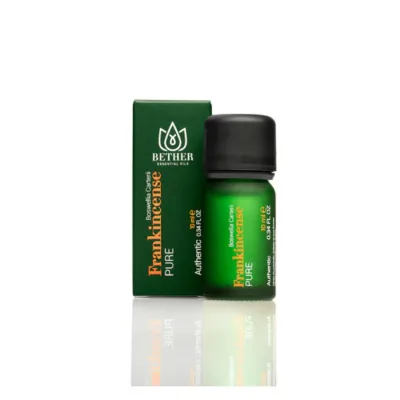
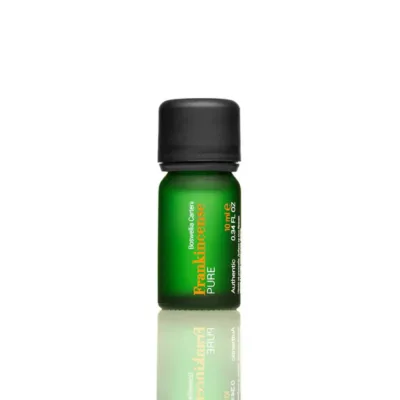
Each oil also carries its own recommended limit, which follows composition rather than aroma. In the Bether range, peppermint sits at up to 0.5% for leave-on products, while lemon and frankincense are at up to 0.15%. A more intense aroma therefore does not automatically mean a lower limit: those are two separate questions, and the answer is checked on the specific oil rather than guessed.
Which carrier oil to choose
The carrier is not merely filler. It decides how long the hand glides, how greasy the skin feels afterwards, and whether the aroma comes through cleanly.
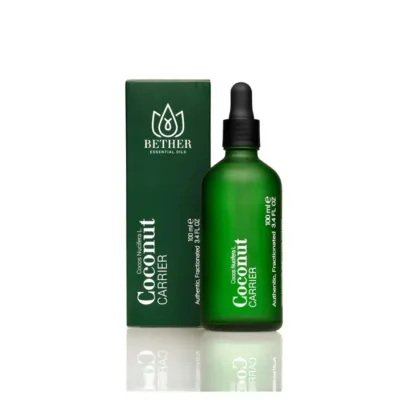
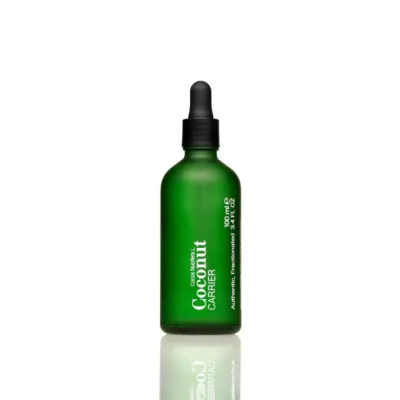
- Fractionated coconut oil - the default choice for massage. Odourless and colourless, so it does not interfere with the essential oil. Liquid at any temperature, long slip, absorbs without a heavy film, and does not go rancid.
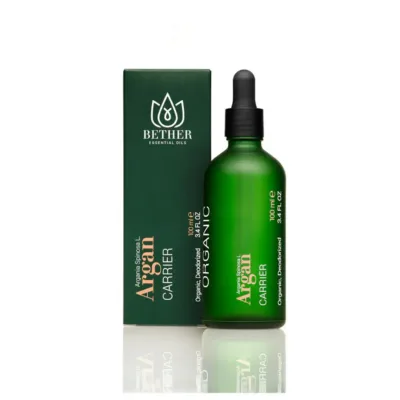
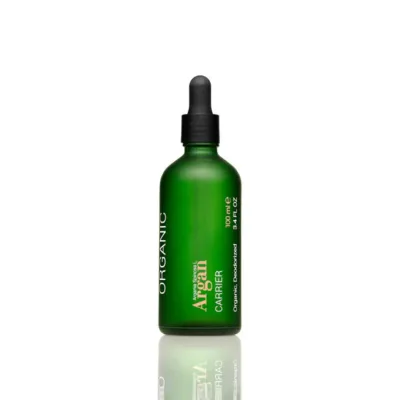
- Argan oil - the richer choice for dry and mature skin. It adds vitamin E and unsaturated fatty acids, so it cares for skin while carrying the aroma. It has a light aroma of its own and costs more, which is why many people cut it half and half with coconut.
Both, along with the essential oils, are on the essential oils page. Kitchen olive oil is not an alternative: it is heavy, it smells, and it fights the aroma you are trying to build.
How to mix it, step by step
To make massage oil you need no equipment. A dark glass bottle, the carrier oil and the essential oil are all it takes. If the bottle has a pipette, so much the better, but the dropper on the essential oil does the job by itself.
- **Carrier oil first. **Measure 20 ml into the bottle. That way the drops land in a lipid and dissolve immediately.
- **Then the drops. **Add the essential oil drop by drop and count them. Two extra drops in 20 ml shift the concentration by about 0.5 percentage points, which at the low end of the range is a doubling.
- **Shake gently. **A few inversions are enough. Both ingredients are lipids, so vigorous mixing is unnecessary.
- **Leave it an hour. **The aroma distributes and softens. Judged straight away, it will seem sharper than it is.
- **Label it. **Oil and date. In a month, three identical brown bottles look exactly alike.
Three recipes to start with
Each is for 20 ml of carrier oil. Mix in a dark glass bottle and shake gently.
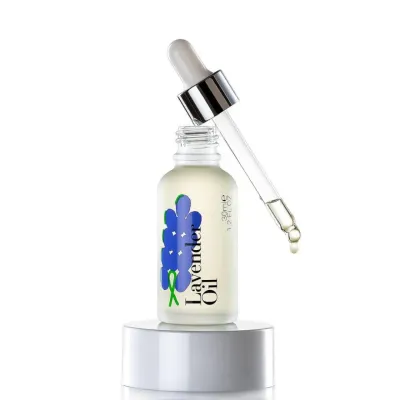
- **For evening wind-down: **3 drops lavender + 1 drop frankincense in 20 ml fractionated coconut oil. Frankincense is a base note and holds the lavender considerably longer.
- **For freshness and waking up: **2 drops lemon + 1 drop peppermint in 20 ml fractionated coconut oil. Evenings or sunless days only: lemon oil is photosensitising.
- **For dry skin: **3 drops lavender in 20 ml argan oil. Here the carrier does half the work and the aroma is secondary.
Storage and shelf life
Use a dark glass bottle. Light is the blend’s main enemy, and plastic reacts with essential oils over time. Keep it dry and cool, away from the window.
Make small batches
Make small batches: 20 to 50 ml at a time. A homemade blend has no preservative and has not been stability tested, so no exact date can be given, though it is clear what sets it. Fractionated coconut oil is saturated and effectively does not go rancid. The constraint is the essential oil: its monoterpenes are oxidised by oxygen into hydroperoxides, which are stronger sensitisers than the parent compound. An old blend is therefore not merely weaker in aroma, it is riskier on skin. If the aroma has changed, throw it away.
For scale: 20 ml covers about five back massages, or two weeks if you use the blend nightly on hands and feet. One 100 ml bottle of carrier makes five such blends, and a 10 ml essential oil will outlast all of them. So the first purchase is a pair, but after that you are only replacing the carrier.
Before first use
- External use only. Essential oils are not taken internally.
- Patch test: a small amount on the forearm, wait 24 hours.
- A blend with citrus oil should not be applied before sun exposure.
- Avoid eyes and mucous membranes. Not for babies or young children.
- If pregnant or managing a chronic condition, consult a doctor.
- Discontinue use if irritation occurs.
And the boundary that applies to all of aromatherapy: massage oil is care and comfort, not treatment. Pain or a persistent complaint belongs with a professional.