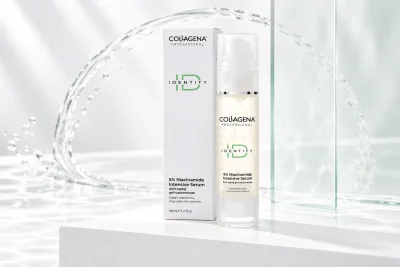
What Azelaic Acid Is
Azelaic acid is a dicarboxylic acid with nine carbon atoms. That sounds like textbook chemistry, but the molecule is a familiar one for skin: it occurs naturally in grains such as wheat, rye and barley, and the Malassezia yeasts that live on everyone’s skin produce it too. Cosmetics and medicines use a synthesised form, so that the amount and the purity are exact.
An Acid Unlike the Others
The word “acid” makes most people think of a peel: AHAs loosen the bonds between dead cells on the surface, and salicylic acid does the same inside the pores. Azelaic acid does not work that way. It does not take a layer off the skin; it acts on processes within it: how the cells at the opening of the pore renew, how active the bacteria there are, and how much melanin is made.
Even so, products with it are often called exfoliants, because they help the skin renew evenly, yet they feel far gentler than a classic acid peel. That gentleness is also why you find it in care for skin that cannot take strong acids.
How It Works: Three Effects in One Ingredient
What makes azelaic acid so valued by dermatologists and beauticians is that one molecule acts on three separate processes. In blemish-prone skin those three usually travel together, while most ingredients cover only one of them.
Pores and Blemishes
Blemishes start when the cells lining the pore do not shed in time, mix with sebum and form a plug. Azelaic acid normalises the renewal of those cells, so the channel stays clearer. At the same time it holds back Cutibacterium acnes, the bacterium that multiplies inside a blocked pore.
One detail matters: no resistance of that bacterium to azelaic acid has been described. So it can be used for months without losing its effect, unlike some antibiotics used for acne. How the different kinds of blemish form is explained in the article on acne and sebum.
Dark Marks and Uneven Tone
Azelaic acid inhibits tyrosinase, the enzyme pigment cells use to make melanin. What sets it apart is that it acts mainly on overactive pigment cells and affects normal ones far less. In practice, dark spots fade while the surrounding skin rarely lightens unevenly.
That is why it is used for post-acne marks, for an uneven tone and as part of the care for melasma, including on darker skin, where aggressive treatments risk leaving new marks. In comparative studies on melasma, a 20% azelaic acid cream performed comparably to 4% hydroquinone, the classic spot-lightening ingredient, and better than 2% hydroquinone. More on how pigmentation forms is in the article on hyperpigmentation.
Redness
The third effect is anti-inflammatory. Azelaic acid reduces the free radicals that inflamed skin produces and dampens the signals that keep redness going in rosacea-prone skin. That makes it one of the few actives that reactive skin often tolerates well.
If the redness is constant, see the article on rosacea and couperose, which explains when it is a question for a dermatologist.
Which Skin It Suits
Azelaic acid is a logical choice when:
- your skin is oily or combination and prone to blemishes;
- every breakout leaves a dark mark that takes months to fade;
- your tone is uneven or you have sun spots;
- you have redness and stronger acids irritate you;
- you are looking for an active during pregnancy or breastfeeding, after talking to a doctor.
The last point matters to many women. Azelaic acid is usually regarded as suitable during pregnancy, because the skin absorbs only a small part of it and animal studies have not shown birth defects. Human data are limited, so the decision is always made together with your doctor. Which ingredients to pause and which to keep is covered in the article on skincare during pregnancy.
When It Is Not the First Step
If your skin is dry, tight and flaking and its barrier is compromised, any active will sting more than usual. Start by repairing the skin barrier and bring in azelaic acid after that.
With painful bumps under the skin, with scarring, or with acne that gets worse despite good care, see a dermatologist. Cosmetic care runs alongside treatment, not instead of it.
10%, 15% or 20%: Cosmetic and Medicinal
Azelaic acid lives in two worlds. Medicinal products contain it at 15% (a gel and a foam, most often for rosacea) and 20% (a cream, most often for acne), and are used as a doctor directs. Cosmetic products usually go up to 10%.
The difference is not only the number. Medicinal forms are clinically tested for a specific condition, while cosmetic ones are made for everyday care of how the skin looks and feels. For most people without a diagnosis, a cosmetic strength of up to 10% is a good start for clearer-looking skin and a more even tone when the product is used regularly over months.
The Formula Matters as Much as the Percentage
Azelaic acid dissolves poorly in water. So formulators either suspend it in a cream or dissolve it with the help of glycols. That affects the texture, how evenly it spreads and how it feels on the skin.
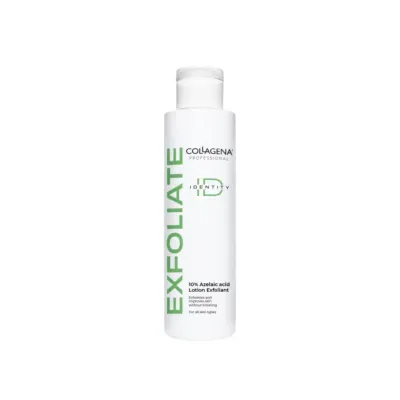
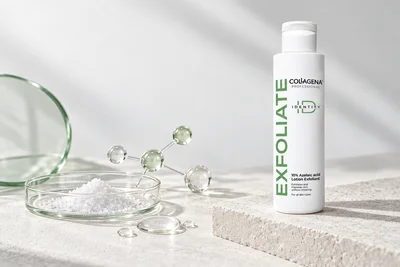
If you read the ingredient list of the Collagena Professional 10% Azelaic Acid Lotion Exfoliant, you will see propylene glycol right after water, with azelaic acid third. That is how it ends up dissolved in a light lotion applied with a cotton pad rather than in a heavy cream.
Do not compare products by percentage alone. A well-formulated 10% lotion that you use regularly will do more than a stronger product that irritates and gets abandoned after a week.
How to Use It at Home
Apply it to clean, completely dry skin, over the whole area that is prone to blemishes or marks, not only on spots. Azelaic acid also works ahead of time, on pores that have not yet become inflamed. Follow it with a moisturiser.
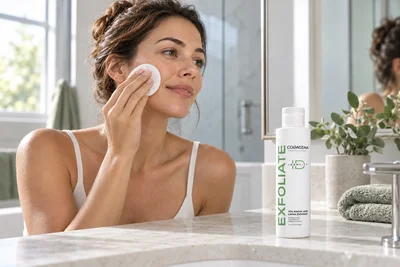
Start with a few evenings a week and follow the instructions of the specific product. The Collagena Professional lotion goes on with a cotton pad and is not rinsed off. For milder concerns it is used three times a week, and for more marked ones every other evening. If you are not sure which schedule is right for you, ask a beautician.
Morning or Evening
Azelaic acid does not make the skin more sun-sensitive the way AHAs and retinol do. So it can be used in the morning too, under sunscreen. The evening is still more convenient, because your morning routine already holds vitamin C and sunscreen.
Sunscreen is a must if dark spots are your goal. Without it, melanin comes back faster than any ingredient can hold it down. How to choose protection is covered in the article on photoprotection, and the products are gathered under sun protection.
Stinging in the First Weeks
Mild stinging, itching or a feeling of warmth for a few minutes after applying are the most common reactions in the first week or two. They usually settle as the skin gets used to it.
If the stinging is strong, lasts long, or the skin starts to redden and peel, use it less often and check that you are applying it to completely dry skin. If the reaction does not settle, stop the product.
What It Pairs With
Azelaic acid is one of the easiest actives to combine. Here is how it sits next to the ones you probably already use:
| Ingredient | Together? | How |
|---|---|---|
| Niacinamide | Yes | In the same routine. The two complement each other on marks and redness. |
| Hyaluronic acid, panthenol | Yes | After the azelaic acid, for hydration and less stinging. |
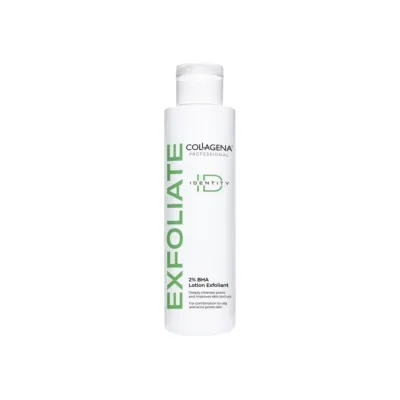
| Salicylic acid (BHA) | With care | On different evenings, or BHA only on the T-zone. |
| AHAs | With care | On different evenings. Together they are used in salon peels, under supervision. |
| Retinol | Yes, gradually | On different evenings, or azelaic acid in the morning. |
| Vitamin C | Yes | Vitamin C in the morning, azelaic acid in the evening. |
The principle is simple: azelaic acid on its own is gentle, but every further strong active on the same evening adds to the load. Introduce one new active at a time and wait about two weeks before adding the next.
When You See Results
The timings below are a guide and come from studies on the ingredient. They depend on the strength, the formula and your own skin, but they show what to expect with regular use:
- Around 4 weeks: the skin is smoother and less shiny, and new blemishes are fewer and settle faster.
- 2 to 3 months: the marks left by blemishes visibly fade and the tone is more even.
- 3 to 6 months: sun spots and melasma respond the slowest and need sun protection every day.
If after three months of regular use you see no change at all, a different approach is probably needed, and it is worth asking a dermatologist.
Azelaic Acid in the Salon
In the salon azelaic acid rarely works alone. In the Collagena Professional range it is found in two products with different roles: an acid peel applied only in the salon, and a lotion used both in the salon and at home.
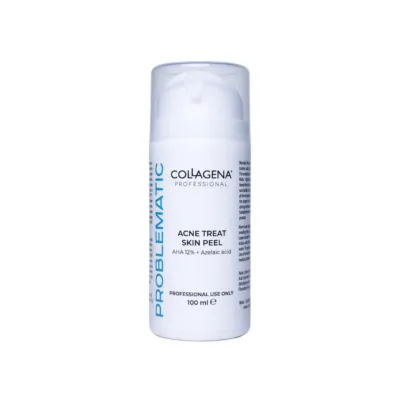
Acne Treat Skin Peel 12%
Acne Treat Skin Peel 12% combines azelaic acid with four AHAs: lactic, glycolic, citric and malic. The AHAs exfoliate the surface while the azelaic acid works on sebum and pores. The peel is applied only by a beautician, left on for up to 8 minutes depending on the skin, and is part of the therapy for oily, problem and acne-prone skin with a 12% AHA peel. Sun protection after the treatment is a must.
How a course of peels is planned and how peels combine with active serums is described in the professional guide to chemical peels. All the peels in the range are gathered under peels and exfoliants.
10% Azelaic Acid Lotion Exfoliant
The lotion is used in the salon in the deep cleansing therapy for acne-prone and problem skin, and is then used at home between treatments. Besides 10% azelaic acid it contains a peptide (palmitoyl pentapeptide-4), hyaluronic acid, a natural polysaccharide that balances and soothes, green tea extract and collagen hydrolyzate of 99.5% purity. It is made for oily, combination and blemish-prone skin.
If you would like a treatment with these products, look for a salon that works with Collagena Professional near you and ask about its therapies for problem skin. The beautician will judge whether your skin is ready for a peel or whether it is better to start with home care alone. If you work in a salon, the step-by-step protocols are on the therapy pages, and the partner programme gives access to the professional products and to training.
Azelaic, Salicylic or Niacinamide: How to Choose
The three are often mentioned together because all of them help blemish-prone skin. The difference is which problem leads:
- If the main issue is shine, blackheads and congested pores, start with salicylic acid: it dissolves in sebum and works inside the pore.
- If the main issue is the dark marks after every breakout and the redness, azelaic acid covers both at once.
- If your skin is sensitive or dehydrated and you want a gentle ingredient for every day, niacinamide is the easiest start.
The three do not exclude each other. A well-tolerated plan for combination skin is niacinamide in the morning, azelaic acid three evenings a week, and BHA on one or two of the other evenings, on the T-zone only. A full step-by-step routine is in the article on care for acne-prone skin, and the products by concern are gathered under acne-prone skin and pigmentation.
In Short
Azelaic acid is gentle but versatile. It normalises cell renewal in the pores, holds back the bacteria involved in blemishes, fades dark spots and calms redness. It suits oily, combination and reactive skin, combines easily with niacinamide and vitamin C, and is usually considered suitable in pregnancy after talking to a doctor. The result comes gradually, over weeks and months, and only holds with sun protection every day.
Sources
The statements in this article concern the ingredient in general, not a specific product. Titles are given in the original so you can check them:
- Sieber M. A., Hegel J. K. E. Azelaic acid: properties and mode of action. Skin Pharmacology and Physiology, 2014.
- Schulte B. C., Wu W., Rosen T. Azelaic acid: evidence-based update on mechanism of action and clinical application. Journal of Drugs in Dermatology, 2015.
- Sauer N. et al. The multiple uses of azelaic acid in dermatology: mechanism of action, preparations, and potential therapeutic applications. Postępy Dermatologii i Alergologii, 2023.
- Searle T., Ali F. R., Al-Niaimi F. The versatility of azelaic acid in dermatology. Journal of Dermatological Treatment, 2022.
- Coda A. B. et al. Cathelicidin, kallikrein 5, and serine protease activity is inhibited during treatment of rosacea with azelaic acid 15% gel. Journal of the American Academy of Dermatology, 2013.
- Verallo-Rowell V. M. et al. Double-blind comparison of azelaic acid and hydroquinone in the treatment of melasma. Acta Dermato-Venereologica, 1989.
- Balina L. M., Graupe K. The treatment of melasma: 20% azelaic acid versus 4% hydroquinone cream. International Journal of Dermatology, 1991.
- Chien A. L. et al. Treatment of acne in pregnancy. Journal of the American Board of Family Medicine, 2016.
This content is for educational purposes and does not replace professional advice. The studies referenced concern the ingredient rather than any specific product, and are not a claim about the efficacy of any ONE Cosmetix product. For persistent or severe skin concerns, consult a dermatologist.
Frequently asked questions
What is azelaic acid used for?
For blemish-prone skin, for the dark marks blemishes leave behind, for an uneven tone and for redness. It normalises cell turnover inside the pores, holds back the bacteria involved in blemishes, reduces melanin production in overactive pigment cells and calms the skin.
Can I use azelaic acid with niacinamide?
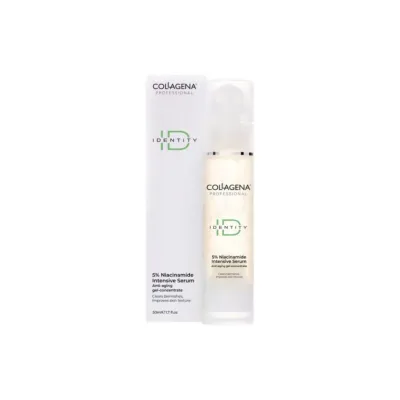
Yes. The two sit well in the same routine and complement each other on marks and redness. Apply the azelaic acid first, then the niacinamide serum or your moisturiser.
Can I use azelaic acid with retinol?
Yes, but not from day one. Introduce them one at a time, and once your skin is used to both, use them on different evenings, or azelaic acid in the morning under sunscreen and retinol at night.
Is azelaic acid suitable during pregnancy?
It is usually regarded as one of the suitable actives during pregnancy and breastfeeding, because the skin absorbs only a small part of it. Human data are limited, so use it after talking to your doctor.
Can I use it in summer?
Yes. Azelaic acid does not make the skin more sensitive to the sun the way AHAs and retinol do. Daily sunscreen is still a must, especially if you are working on dark spots.
Which strength of azelaic acid should I choose?
For everyday care at home, cosmetic products of up to 10% are a good start and are usually well tolerated. Strengths of 15% and 20% are found in medicinal products, used as a doctor directs.
Does azelaic acid help with rosacea?
At cosmetic strength it suits redness-prone skin and is usually well tolerated. Diagnosed rosacea is treated by a dermatologist, who chooses the medicinal form and strength; cosmetic care runs alongside that treatment.
How long before I see results?
Around four weeks for smoother skin and fewer new blemishes, two to three months for the marks they leave, and several months for sun spots. The result only holds with daily sun protection.